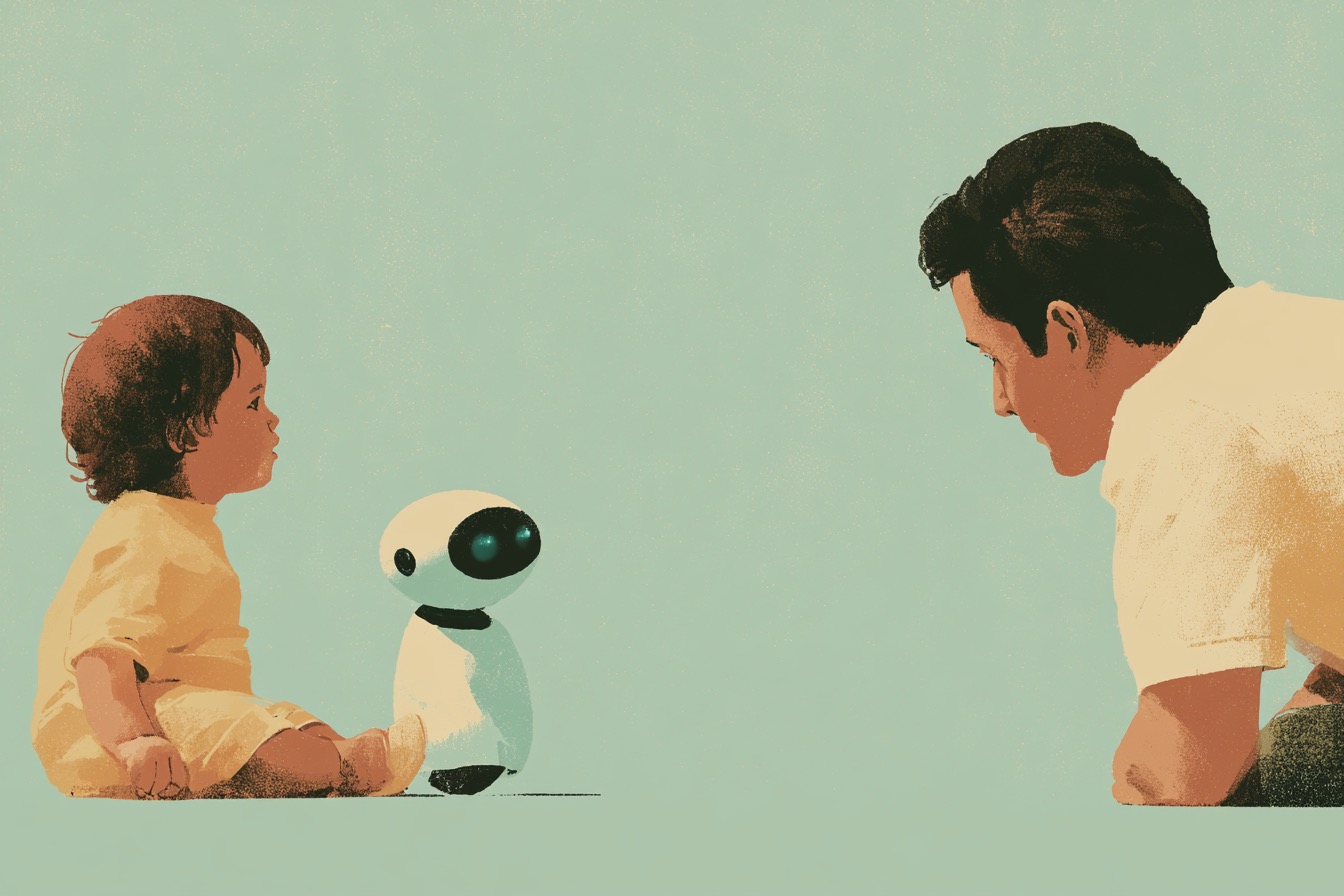
The short answer: AI can be genuinely valuable for children under six, but only in one configuration. The adult operates the tool, the child directs the creation, and the AI never becomes the child’s companion, teacher, or default answer machine. Set it up that way and a three-year-old can design working software. Set it up wrong and you’ve slipped an always-agreeable voice in between your child and the productive struggle that learning actually requires.
This guide covers that configuration in detail: what works, how to set it up safely, what the research says, and what to steer clear of.
The one model that works: parent-mediated creation
In a healthy session, the AI is a power tool the family uses together – closer to a sewing machine than a babysitter:
- The child has an idea (“a game where the digger scoops rocks!”)
- The parent turns it into a prompt and types it
- Software appears; the child plays, evaluates, and directs changes (“make it faster!” “add a dump truck!”)
- Repeat
The child never touches the model directly. What they experience is this: I described something, and it became real. When it was wrong, we said what was wrong, and it got fixed. That’s agency, iteration, and debugging – the heart of computational thinking – delivered at an age when the child may not yet read. (The full session method, with copy-paste prompts for parents, is in 12 Weeks of Tech Projects for Toddlers .)
The inverse setup – a child talking to a chatbot alone – fails on exactly that dimension. Harvard researcher Ying Xu, in a 2026 UNICEF interview, put the tradeoff plainly: AI can help children explore, but it can also crowd out sleep, friendship, and productive struggle. Productive struggle is the part adults are most tempted to optimize away. A child who learns that not-knowing lasts four seconds before a machine resolves it is learning the wrong lesson about how knowing works.
The adult operates the tool, the child directs the creation, and the AI never becomes the relationship.
Defaults are decisions
A 2026 BSM Media survey found 66 percent of U.S. mothers had used AI tools for product ideas or parenting tips. AI is already in the home; the question isn’t whether but how. And a tool used in front of a child becomes part of the environment – and environments teach.
If a parent asks a machine every question, the child learns where answers come from. If the machine answers instantly and the adult never verifies, the child learns that confidence is the same thing as being right. None of this needs a villain, only unexamined defaults. The practical rules that follow:
- Model verification. Say “let’s check that” out loud sometimes. Let the child see machine answers get tested.
- Preserve not-knowing. When a child asks a question, wonder about it together before you resolve it. The gap is where the thinking happens.
- AI stays behind the parent. The child directs through you. You’re the interface, the filter, and the editor of the syllabus.
Safety setup (30 minutes, once)
For families building with AI tools, the technical setup is short:
- Spending limit on the AI account ($10/month is generous – that’s hundreds of toddler games)
- API keys in a password manager, never written down or shared
- Separate computer account (“Family Coding”) with only a browser and an editor – no email, no saved passwords, no shopping
- Optional but most secure: container isolation so AI-generated code can’t touch anything outside its sandbox
That’s more safety architecture than most kids’ YouTube setups have ever had.

What the research actually supports
Three findings worth knowing, because they cut against the marketing of the “AI for kids” industry:
- Reasoning comes from doing, not from devices. A 2025 IDC study of Bit:sort, a physical sorting activity, found children demonstrating genuine algorithmic reasoning through hands-on play, before they could verbalize it. The thinking comes first, and it lives in the hands.
- Distribution is not education. The micro:bit program has shipped over 11 million devices across 85 countries – and in 2026 its foundation launched a dedicated research lab (with Lancaster University) precisely because handing out hardware and building thinkers aren’t the same thing. If the people who shipped 11 million devices say the device alone isn’t the mechanism, believe them.
- Young children learn through bodies and relationships. The developmental case (Piaget’s preoperational stage, Montessori’s concrete-before-abstract, embodied-cognition research) all points the same way: physical first, digital second , an adult present throughout.
The pattern underneath all three: AI multiplies a parent-child building practice. It can’t stand in for one.
Red flags in “AI for kids” products
When you’re sizing up any AI-branded product for a young child, walk away if:
- It’s designed for solo use. The product’s value depends on removing you. The learning depends on your presence. Those two pull in opposite directions.
- It simulates friendship. A companion that never needs anything from your child, never disagrees, and is endlessly available teaches a strange and wrong lesson about people.
- It answers instead of asks. Tools that resolve every question instantly are optimizing away the struggle that produces the learning.
- “AI” is the feature, not the means. A plush toy with a chatbot inside is a chatbot with fur. Ask what the child actually makes with it. If the answer is nothing, it’s consumption with extra fluff.
- It can’t say what data it collects. A microphone in a child’s bedroom wired to someone’s server deserves exactly the scrutiny that sentence implies.
Frequently asked questions
Is it safe to let my toddler use AI? With the parent-mediated model and the safety setup above — yes, and it’s arguably safer than autoplay video, because nothing happens without you in the loop.
Isn’t this just more screen time? It’s roughly 20–30 minutes a week of creation-mode screen use, which differs from passive consumption in kind, not just degree. Most of the curriculum is entirely screen-free anyway.
Will my kid become dependent on AI to think? The configuration decides it. A child who directs an AI through a parent is practicing specification, evaluation, and iteration. A child left alone with a chatbot is practicing asking. Keep the tool behind you and the thinking stays in front.
Which AI tool should we use? Any major chatbot (Claude, ChatGPT, Gemini) works for game building, and free tiers are plenty. The technique matters far more than the vendor.